
As media and entertainment businesses look ahead to 2026, infrastructure is becoming one of the most important strategic decisions they make. From how content is created and collaborated on, to how it is stored, rendered, archived and ultimately monetised, technology now underpins every stage of the production lifecycle. Cloud, hybrid workflows and AI are no longer emerging trends – they are shaping how resilient, scalable and competitive organisations will be in the years ahead.
A Moment of Perspective
Before looking ahead, it would be remiss not to recognise just how challenging the past year has been for parts of our industry.
The media and entertainment sector is resilient, but 2025 reminded us that even long-established, highly respected businesses are not immune to market pressure, shifting commissioning models, and rising costs. For many teams, the past 12 months have brought uncertainty, difficult decisions, and in some cases, real personal impact.
Those moments matter. Behind every facility, workflow, or pipeline are people – creatives, technologists, producers, whose livelihoods and passion are tied to this industry. Acknowledging that reality is important as we talk about progress and innovation.
At the same time, periods like this often act as catalysts for change. They force hard questions about sustainability, efficiency, and how technology can better support both creativity and commercial resilience. As we look towards 2026, those lessons are shaping a more considered, more flexible approach to infrastructure and production.
Here’s what I believe will shape the next 12–24 months and where IaaS providers like us have both a strategic opportunity and a responsibility to empower our partners.
Hybrid Cloud Becomes the Default, Not the Future
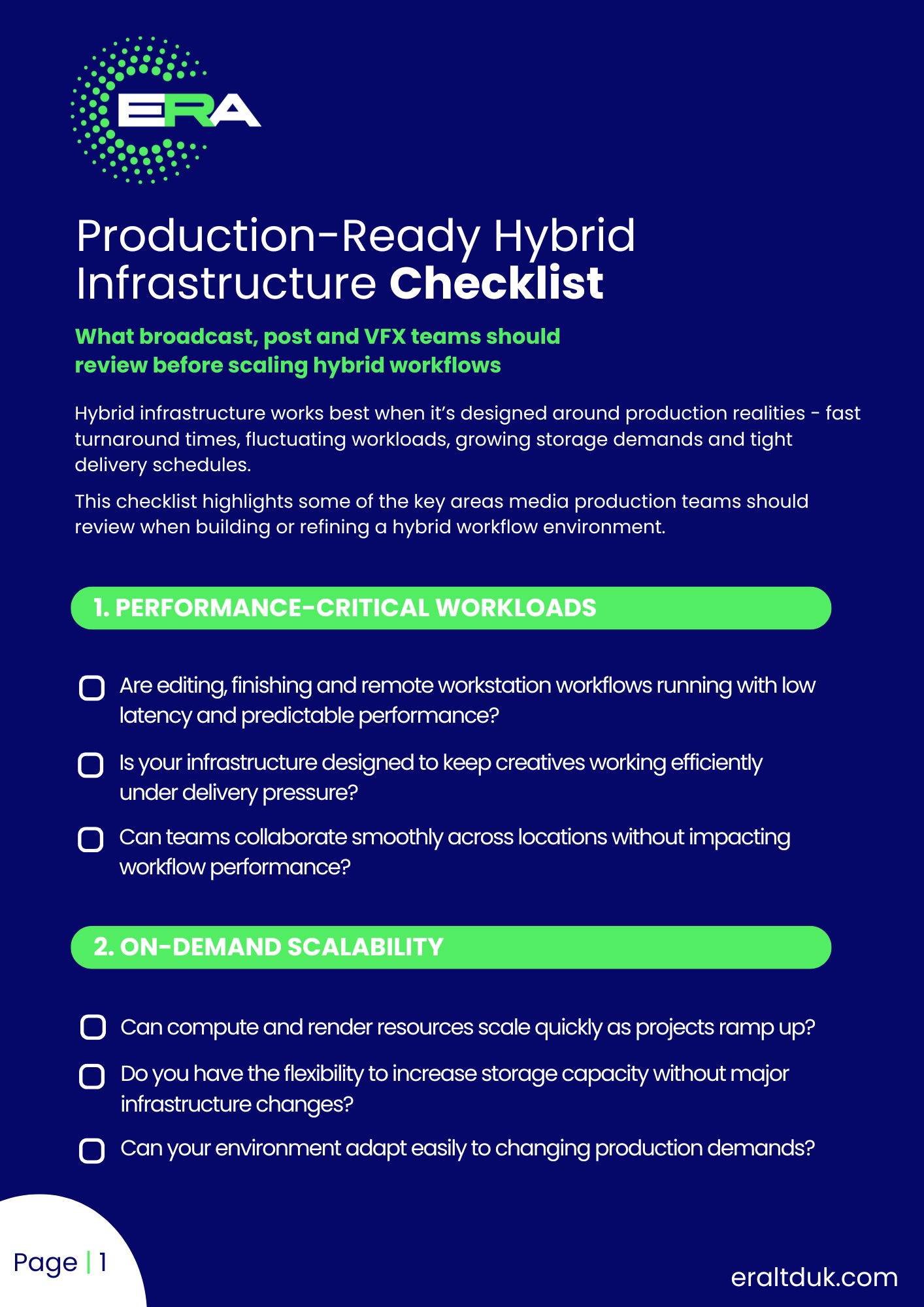
The hybrid cloud will no longer be an optional architecture – it will be the dominant model for production workflows, storage, rendering, and archives. Rather than choosing pure cloud versus pure on-premise, studios and post houses will design their infrastructure around workload needs:
- High-performance, low-latency tasks (remote workstations, active editing, real-time review) will stay close to creative teams.
- Compute power and storage that can be added or reduced as needed, particularly for burst render and nearline, will increasingly be delivered through the cloud to match the pace of each project.
- Deep archive and long-term retention will span on-premise and cloud tiers with smart lifecycle policies that minimise cost without sacrificing accessibility.
For IaaS providers, this means offering integrated hybrid models, metering usage where it matters, and seamlessly integrating multiple storage tiers not just selling more capacity.
Metadata and AI Will Become the Framework for Modern Workflows
Media organisations are drowning in content and the key to unlocking it isn’t just more storage, it’s smarter storage.
In 2026, AI-driven metadata enrichment and intelligent orchestration layers will be a core part of M&E infrastructure, enabling:
- Automated tagging and scene recognition
- Faster proxy creation for remote review
- AI-assisted search across vast libraries
- Triggered workflows (i.e., when a file arrives, automatic transcoding, tagging, archiving)
This isn’t ‘AI hype’ – it’s a practical necessity if studios want to find, reuse, and monetise assets rather than let them sit idle in dark archives.
IaaS partners must prioritise API-driven integrations with AI and orchestration tools. Clients won’t settle for storage that just sits there, they want infrastructure that makes production faster and data more valuable.
Remote Production is Business as Usual
The industry has moved beyond pandemic workaround mode: remote and hybrid work is now deeply embedded in everyday production processes.
The majority of creative professionals now rely on remote collaboration tools as part of their core workflow. What’s shifted is not just where people work, but how infrastructure enables them to work:
- Remote editors, colourists, and VFX artists can collaborate as if they were in the same room
- Remote review systems reduce turnaround times on creative decisions
- Distributed studios can pool talent globally, lowering fixed overheads
For IaaS providers, the differentiator isn’t just spinning up a VM or providing object storage, it’s delivering remote workstation infrastructure that feels local, with predictable performance and low latency.
Cost Efficiency and Total Cost of Ownership Drives Decisions
The economics of content production are shifting. Streaming platforms, broadcasters, and studios alike are under pressure to deliver high-quality content without ballooning budgets.
In 2026, technology investment decisions will be driven by total cost of ownership (TCO), not just initial purchase cost. Legacy platforms with locked-in licences and hidden fees are becoming less attractive, while flexible, scalable models gain favour.
Three implications for IaaS providers:
- Transparent pricing models that scale with usage
- Optimised storage tiering to reduce long-term archive costs
- Consumption-based compute that minimises wasted render capacity
IaaS isn’t just a utility – it’s an enabler of financial resilience.
Archive Strategies Will Shift to Integrated and Intelligent Systems
Content libraries are exploding. From evergreen series to short-form web content, archives now represent a strategic business asset, not just a static ‘vault’.
Recent industry data shows M&E companies are planning to shift toward horizontally integrated archiving models that unify asset management and metadata across systems, and support AI-enriched workflows.
In 2026:
- Fragmented silo architectures will give way to unified or hybrid models
- Metadata will be central to workflows – searchable, actionable, and persistent
- Archiving will be automated and policy-driven
IaaS firms that deliver archive orchestration, metadata indexing, and tiered retention policies alongside raw capacity will stand out.
Sustainability and Responsible Tech Matter
Last but not least, sustainability is no longer an afterthought – it’s a business requirement. Reducing carbon footprint through efficient infrastructure and energy-aware technology choices is increasingly important to both clients and suppliers across the media and entertainment ecosystem.
This is something we see first-hand. We recently became B Corp certified, and the response from customers and partners has reinforced just how much this matters. More organisations want to work with suppliers who take a long-term, responsible view, not just on performance and cost, but on environmental and social impact too.
Clients are asking practical, informed questions:
- What’s the energy cost of rendering in the cloud vs on-prem?
- How will resource utilisation be minimised?
- Can we demonstrate measurable emissions reductions?
Offering infrastructure that supports green production workflows isn’t just good for the planet – it’s good for business.
Conclusion: Infrastructure as an Enabler of Creative Agility
2026 will be the year infrastructure stops being just a backend utility and becomes a strategic driver of creativity, efficiency, and competitive advantage in media and entertainment.
For our industry, that means:
- Embracing hybrid models that balance performance, cost, and control
- Leveraging AI to make data intelligible and workflows agile
- Supporting remote and distributed teams without compromise
- Designing systems with sustainability and total cost of ownership in mind
The studios, broadcasters, and post houses that succeed will be the ones that align technology with creative ambition and that’s where IaaS providers can make the greatest contribution.
By Sean Baker, Managing Director – ERA