
Keeping Media Workflows Moving When It Matters Most
Introduction: Production Doesn’t Run Smoothly – And That’s the Point
Media production is unpredictable by nature.
Deadlines shift. Projects scale without warning. Teams expand mid-production. Delivery expectations don’t change.
The real test of infrastructure isn’t how it performs on a normal day; it’s how it responds when demand increases, timelines tighten, and there’s no room for delay.
Hybrid infrastructure is most valuable in these moments.
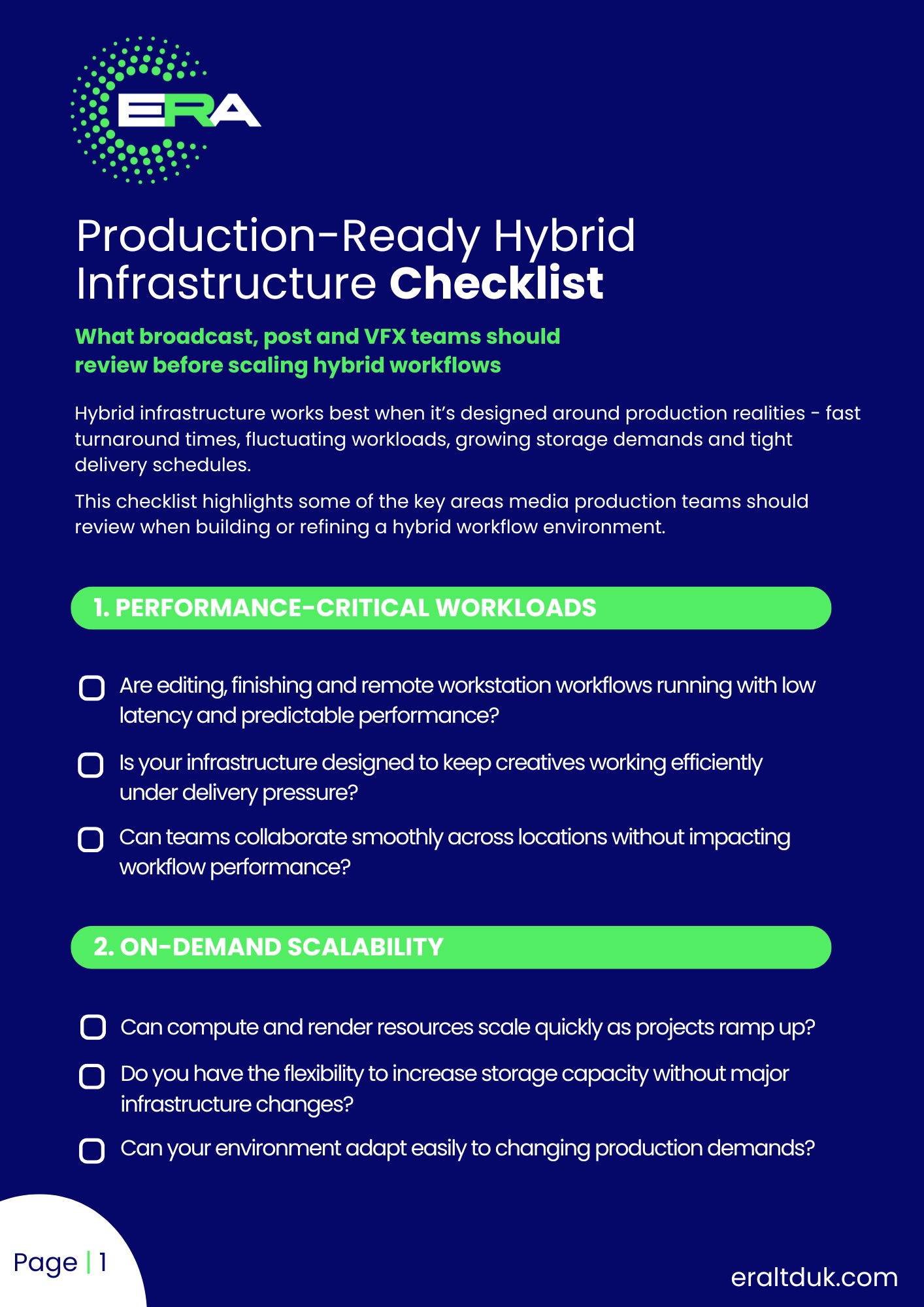
This guide explores how hybrid environments support broadcast, post, and VFX workflows under real production pressure – helping teams stay responsive, scalable, and in control.
Scenario 1: The Render Crunch
The situation
A project moves into final stages and render demand spikes rapidly. What was manageable yesterday becomes a bottleneck overnight.
Without a hybrid approach
- Render queues begin to stack up
- Teams manually prioritise jobs
- Deadlines start to slip
- Expensive hardware sits underutilised once the project completes
With hybrid infrastructure
- Compute scales instantly using on-demand resources
- Render jobs run in parallel, reducing turnaround time
- Capacity is available exactly when needed and removed when it’s not
What this means in practice
Studios no longer need to build for peak demand. They gain access to high-performance compute when it matters most, without carrying the cost permanently.
Scenario 2: Storage Pressure Mid-Project
The situation
As projects progress, storage requirements grow. Active environments begin to fill, and performance starts to degrade.
Without a hybrid approach
- Editing and playback performance is impacted
- Teams begin manually moving or deleting files
- Duplicate versions of media are created to manage space
- Risk of errors and inefficiencies increases
With hybrid infrastructure
- Storage extends seamlessly into nearline or object tiers
- Active environments remain fast and optimised
- Projects can be paused and resumed without disruption
What this means in practice
Storage becomes structured around usage – not just capacity. High-performance environments stay focused on active work, while other tiers handle scale efficiently.
Scenario 3: Scaling Teams Mid-Production
The situation
Additional editors, artists, or freelancers are brought in to meet demand or accelerate delivery.
Without a hybrid approach
- Media is duplicated and transferred between locations
- VPN and bandwidth limitations slow access
- Workstation performance varies between users
- Onboarding new team members takes time
With hybrid infrastructure
- Remote workstations can be provisioned quickly
- Teams access the same centralised data without duplication
- Performance remains consistent regardless of location
- New users can be brought online with minimal delay
What this means in practice
Studios can scale their teams as easily as their infrastructure, without introducing friction into the workflow.
Scenario 4: Tight Turnaround Delivery
The situation
Final changes are required close to delivery deadlines. Time is limited, but expectations remain high.
Without a hybrid approach
- Limited compute slows iteration
- Teams wait on renders and processing
- Increased pressure on internal systems
- Higher risk of missing delivery timelines
With hybrid infrastructure
- Compute and storage scale immediately to meet demand
- Iteration cycles become faster and more efficient
- Teams can respond quickly to last-minute changes
What this means in practice
Speed isn’t just about performance – it’s about responsiveness. Hybrid enables teams to adapt quickly without compromising output.
What These Scenarios Have in Common
Across each of these situations, the same pattern emerges.
Production workflows don’t fail because of a lack of infrastructure; they struggle when the infrastructure is unable to adapt.
Hybrid environments work because they allow different parts of the workflow to operate where they perform best, while scaling seamlessly when demand changes.
In practice, this means:
- Performance-critical work remains stable and predictable
- Compute and storage scale only when required
- Workflows aren’t forced into a single environment
The result is a production setup that supports the way teams actually work, not a fixed model that creates limitations.
Where Does Your Workflow Feel the Pressure?
Most production environments experience friction somewhere.
It often shows up as:
- Render queues building up at key stages
- Storage performance dropping mid-project
- Remote users struggling to access media efficiently
- Teams working around infrastructure limitations
- Deadlines becoming harder to meet due to system constraints
These aren’t isolated issues – they’re signs that infrastructure isn’t scaling in line with production demands.
The Takeaway
Hybrid infrastructure proves its value when production is under pressure.
It allows studios to maintain performance where it matters, scale resources when needed, and keep workflows moving without disruption.
The goal isn’t to change how production works, it’s to ensure infrastructure can keep up with it.
What’s Next?
If your workflow is experiencing pressure in any of these areas, it may be time to look at how your infrastructure is supporting or limiting your production.
Designing a hybrid environment around real workflows can unlock greater flexibility, faster turnaround, and more consistent performance across every stage of production.